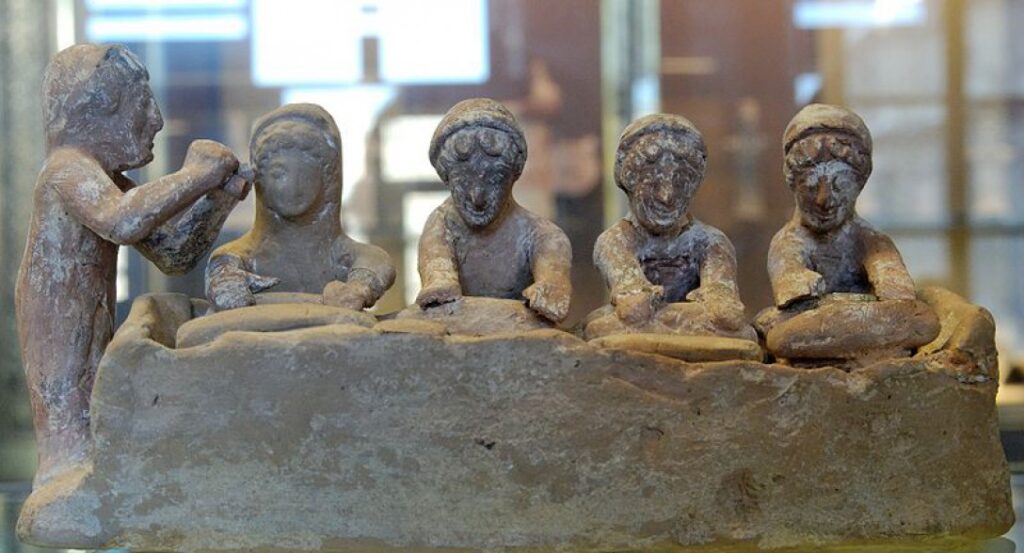

In Sfakia, a mountainous area of Southwestern Crete that falls into the sea, and specifically in Loutro village, there is the custom of offering man-shaped breads to St. Antonios on the 17th of January, date of his name’s celebration.
The custom of anthropomorphic breads or foods is found in several cultures. Small anthropomorphic breads, known as “muertitos,” and skulls made of spun sugar, are basic elements in the Day of the Dead in Mexico. The Christ resurrected in paste of almonds is a product of Liguria of Italy, in order to celebrate His triumph on the Death. In Transylvania, breads in shape of baby are known as the small fathers of the house. Despite the prohibition of the Council of Liptin at 743 AD, on the making idols of flour, the small fathers did not stop exist.
In Greece, anthropomorphic sweet breads as Lazarakia and Easter breads are connected with the Ressurection of Christ. However they also symbolize the ressuraction of nature, the abudance and fertility.
The anthropomorphic breads and cakes have their roots in a very distant past, when fertility symbolism was a basic element in several rites and feasts. Arrephoria was an Athenian hidden rite revolving around two virgin priestresses of goddess Athena, called Arrephoroi, which perhaps means ‘Carriers of Unspoken things’. These unspoken things were snakes and phallos made of dough, both symbols of fertility. Haloa was athenian women’s orgiastic festival, in honor of Dionysos and Demeter. The word Haloa comes from the ancient Greek word halos which implies the threshing floor. The feast included phallos and pudenda-shaped breads.
The anthropomorphic bread is strong development of the human sacrifice. Homer describes a such ritual killing saying that Achilleus demanded the sacrifice of 12 noble young Trojans on Patroclus funeral pyre. However, in Greece the human sacrifices were rather scanty. Soon they were replaced by artifacts, personal objects or man-shaped breads.
The difference between breads of St. Antonios and the anthropomorphic Easter breads is that the first ones are oblations, not festive breads. St. Antonios is seen as one of the founders of Christian monasticism but the Sfakians consider him as a healer. If they or their families or even their animals become ill, the Sfakian women make and offer breads in the shape of the sick person or animal, or in the shape of the sick part of the body (legs, arms, etc.) The bread is given after the cure, in exchange of the received health. On the 17th of January, these breads are placed in front of the sanctuary in the cavernous temple of St. Antonios, and after the liturgy are cut into small pieces and offered to the congregation. This custom has been waning in recent years, and the bread-oblations are quite simple, even abstract. However, in past the appearance of these breads was quite elaborated and was a subject of an informal competition between the makers.
Parke H.W., Festivals of the Athenians, Cornell University Press, 1994.
Burkert W., Greek Religion, Harvard University Press, 1985.
Adkins L. & Roy A. Adkins R., Handbook to Life in Ancient Greece, Oxford University Press, 1997.
Psilakis N., The Anthropomorphic oblations of Loutro, Crete Geographic, no 1, p. 59-73.
Wittkop- Menardeu G., Edodimoi anaparastaseis morfon, Image 11, 1972, p. 17-24.