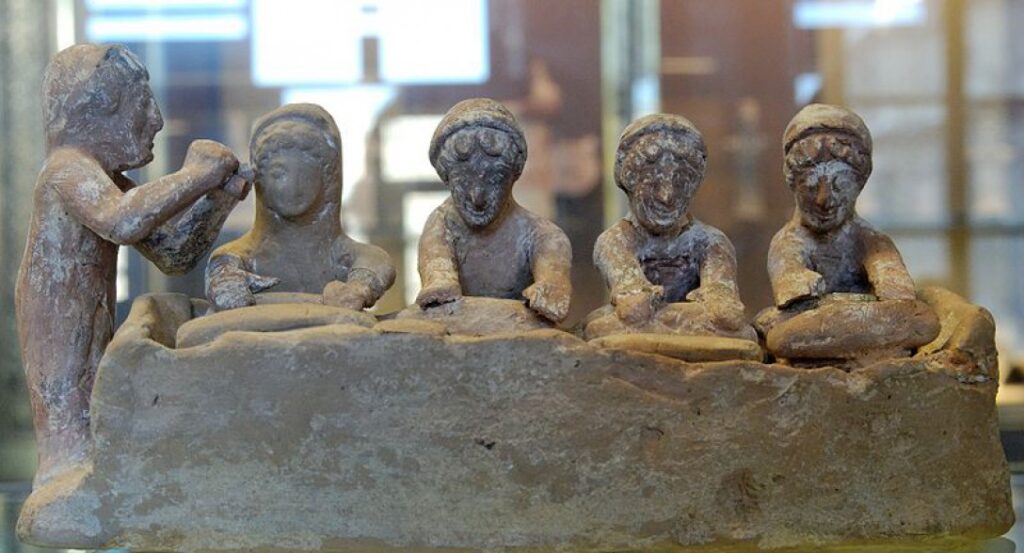

An ancient Roman festival known as dies rosationis or rosalia in May or June, when family members brought roses to the graves of their beloved is the reason for the Greek feast of Rosaliou. On the 2nd of June people decorate the graves with flowers and take to the church kollyva, pies (psychopites: soul pies), lamb and other foods which are blessed by the priest after which they are distributed amongst those present. Thus the dead eat and the souls rest in peace.
In some parts of Greece “The whole village […] makes its way to the tombs. It is the last day of freedom for the souls, which have been freed since the Sunday before Lent by the blood of hens slaughtered over their graves. […] The central part of this ritual is the gonatisma (kneeling) which takes place after the first part of the service has been sung inside the church. Everyone, young and old, walks in procession to the churchyard (perivolos) led by the women, who carry baskets of offerings covered with fine scarves, usually white.
The women stay at the tombs to guard the offerings, kneeling with heads bent towards the earth, while the priest takes the men back to the church to continue the service also kneeling.
During this silent kneeling the souls are believed to rise to eat and drink. Afterwards the men come out of the church ans sit round the tombs in a large circle while the women hand round food and drink.
The separation of men and women during the vital moments of this ritual illustrates the importance of woman in matters so intimately concerned with the dead.” (The Ritual Lament in Greek Tradition, Margaret Alexiou, Dimitrios Yatromanolakis, Panagiotis Roilos)
Food for the dead (1)
Food for the dead (1)






Leave a Reply to Mariana Cancel reply